

The Southwest of North America is extremely rich in rock art images of quadrupeds that are mainly executed as petroglyphs. One of the sites featuring many petroglyphs of quadrupeds (mainly sheep and some deer) is Shay Canyon, a tributary of Indian Creek, a drainage which empties its waters into the Colorado River, further west. Discussed in this study are peculiarities concerning the manufacture of several quadrupeds that combine the techniques of pecking with incision; especially the legs. In my opinion incision may have been used (afterwards) because the technique is more ergonomic, but the true reason is still enigmatic.
By Maarten van Hoek
*
*
Peculiar Petroglyphs of Quadrupeds
The Case of Shay Canyon, Indian Creek, Utah
Maarten van Hoek
*
Introduction
Scenic Shay Canyon houses one of the numerous rock art sites recorded in Utah, SW North America. The canyon is a tributary to Indian Creek Canyon (which empties its waters into the Colorado River, further west), where at least four rock art sites were surveyed by my wife Elles and me in 2005. All four sites have petroglyphs (three sites marked in Figure 1), while at least two of them (labelled Indian Creek 1 and 2 by me) also have at least one panel with faint pictographs. Best known in the canyon is the (fenced off, yet vandalised) Newspaper Rock with an enormous collection of very old and more recent petroglyphs, mainly depicting anthropomorphs (some on horseback), zoomorphs, human footprints and handprints and animal tracks (and much more).
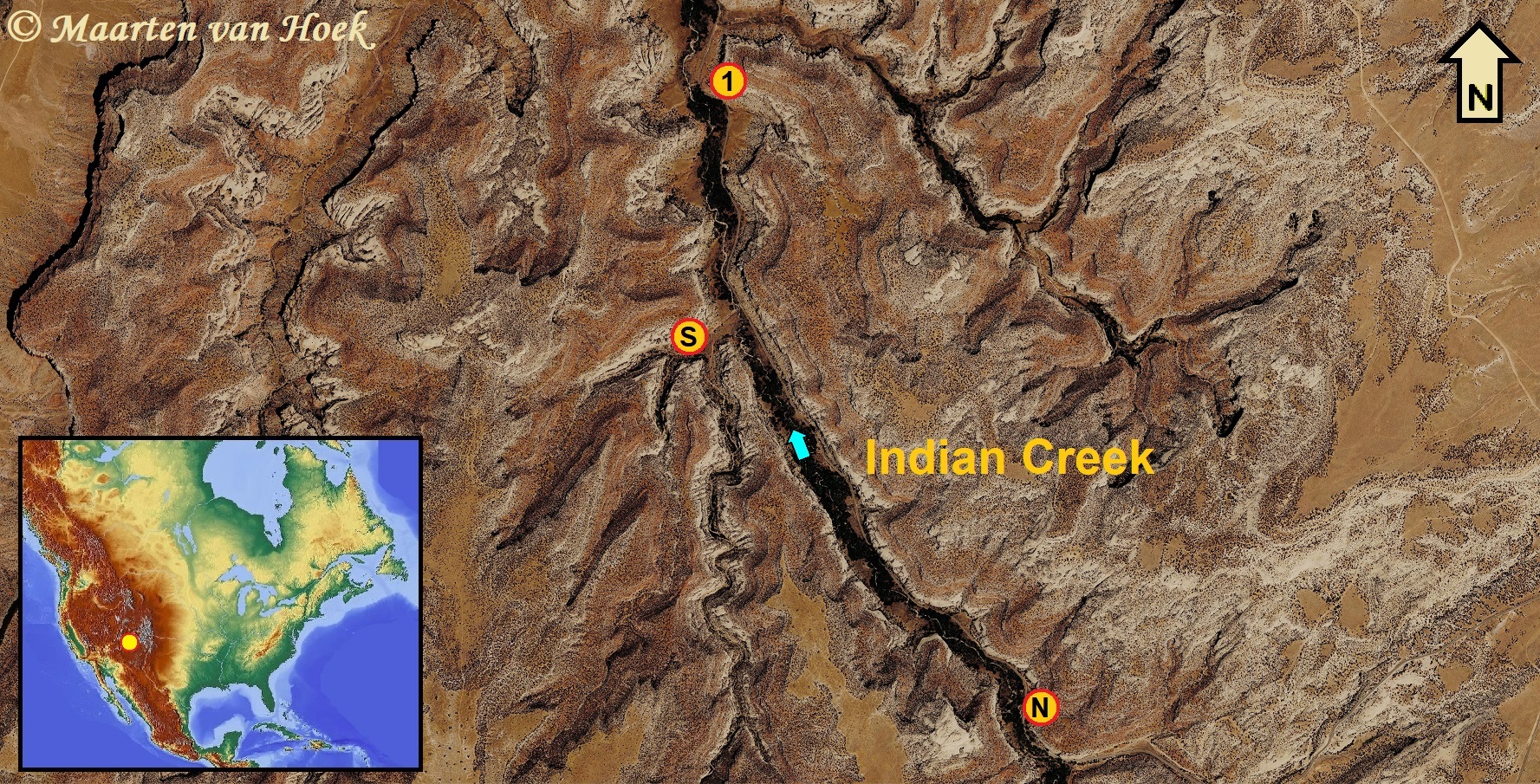
Figure 1. The location of Shay Canyon (S), Utah. N: Newspaper Rock; 1: Indian Creek Site-1. The area is also very approximately marked by a yellow dot in the inset-map of North America. Maps © by Maarten van Hoek, based on Google Earth and (inset) on the map © by OpenStreetMap – Contributors.
All illustrations may be enlarged.
The Newspaper Rock site has been described as Indian Creek State Park by Kenneth Castleton (1987: 198), while Shay Canyon (3 km NW of the Newspaper Rock; see Figure 1) and possibly some others are labelled and assembled as “Indian Creek” by him, only mentioning sites “on both sides of Indian Creek Canyon”, without describing any of them individually (1987: 199-203). Dennis Slifer briefly describes only Shay Canyon (2000: 124-125) and Newspaper Rock, but both authors do not seem to describe the two (possibly more) rock art sites further north of Shay Canyon (Indian Creek 1 and 2), and consequently the two pictograph panels are also not mentioned by them (see the Addendum and Figure 14 at the end).
We did not take the trouble to count all images that we have seen at any of the four rock art sites that we visited (and we certainly missed “some” panels and/or images), but at Shay Canyon there possibly are two or three hundred of petroglyphs distributed across two cliff-faces. The east facing cliff has only one “large” panel on outcrop (Figure 2), while the south facing cliff has many panels, mainly on outcrop faces. This cliff-face stretches for about an (estimated) 200 meters (the decorated panels are hard to distinguish in Google Earth 2026). It is not attempted in this study to exactly pinpoint the decorated panels (we never used GPS during our surveys), but some individual images will be marked on some of the photographs.
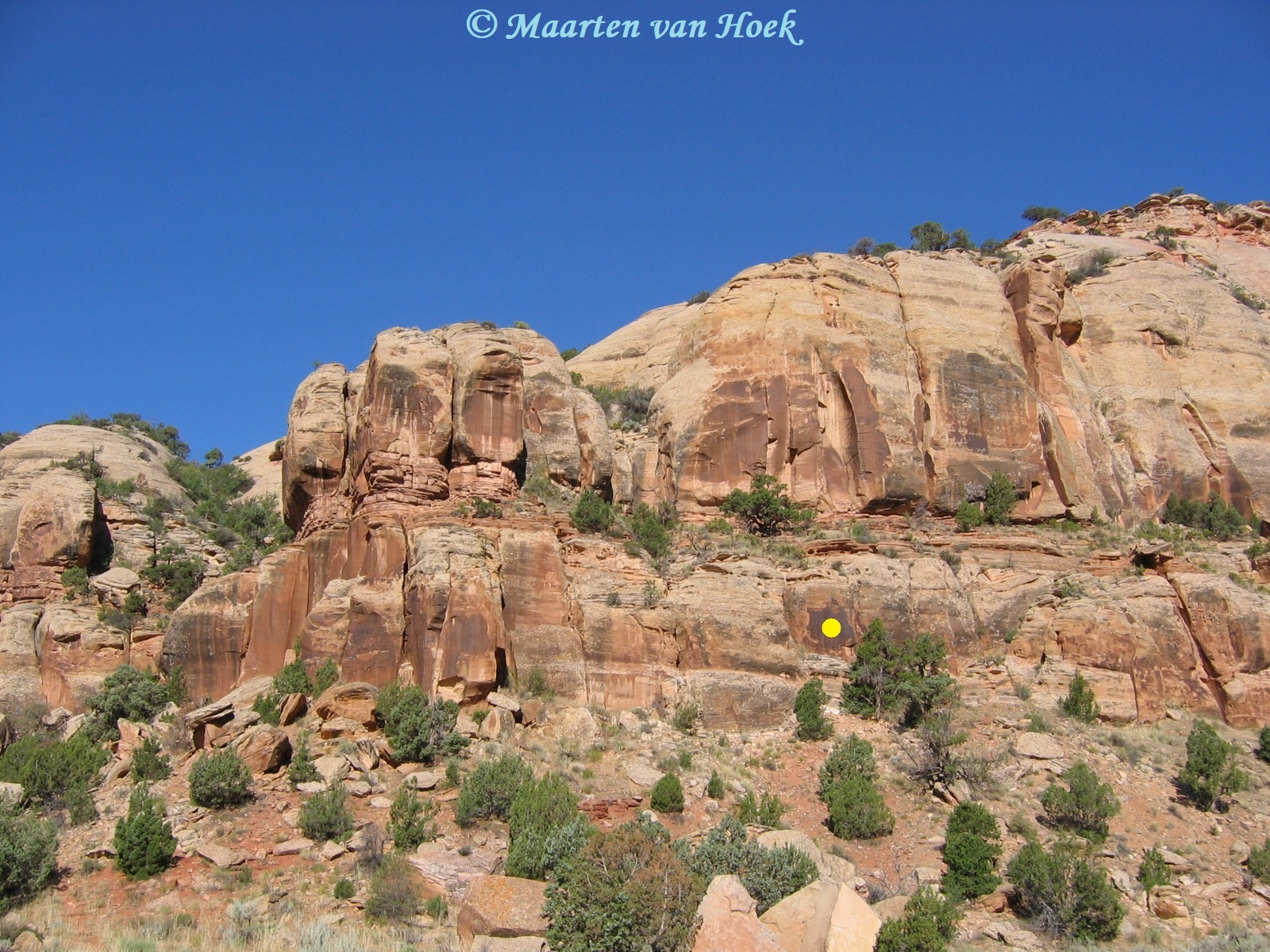
Figure 2. The east facing cliff at Shay Canyon, Indian Creek, Utah, with the single panel with petroglyphs marked with a yellow dot (see Figure 3 for a close-up photo of the panel). Photograph © by Maarten van Hoek.
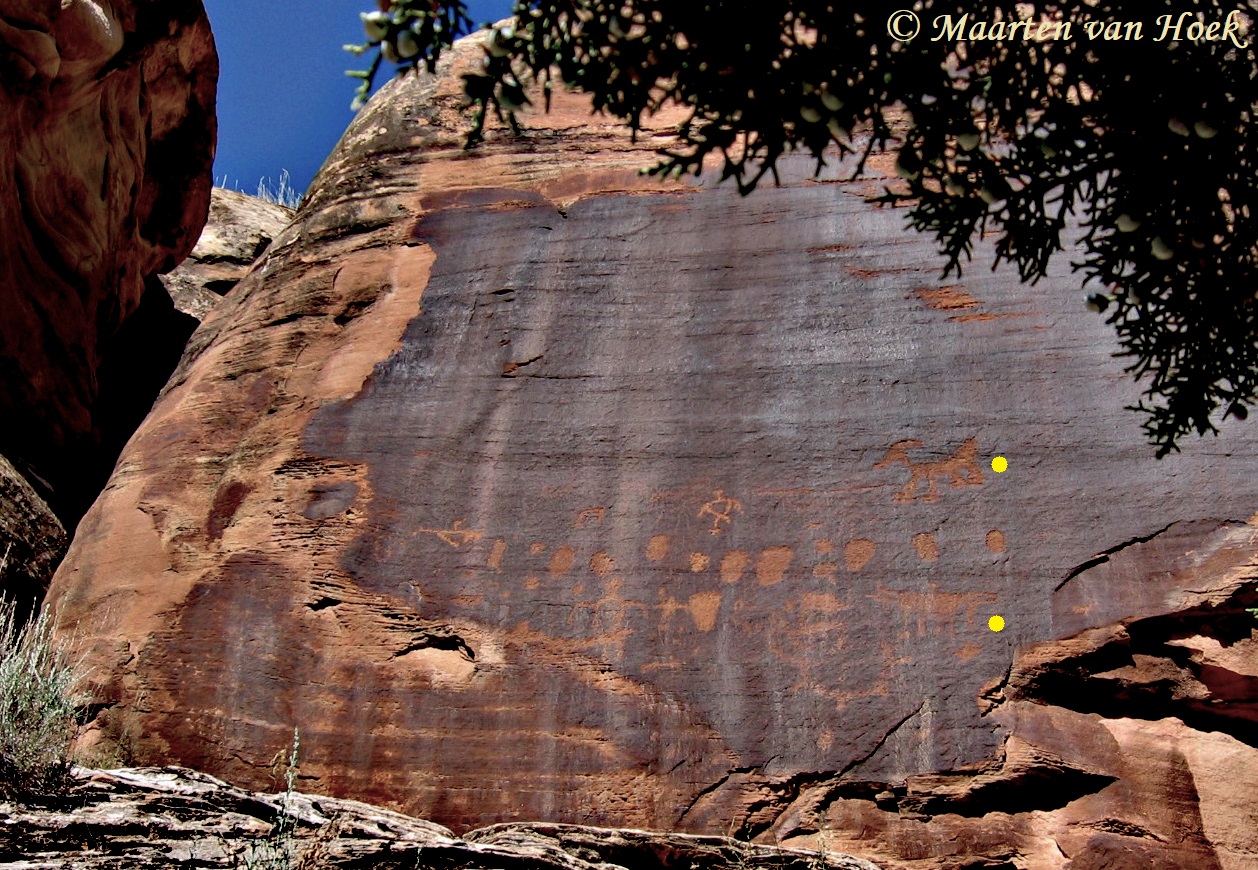
Figure 3. Close-up of the panel at the east facing cliff at Shay Canyon, Indian Creek, Utah. Photograph © by Maarten van Hoek.
*
Shay Canyon Petroglyphs
There is a large variety of images at Shay Canyon, which will not all be described in detail, except for – the subject of this study – images of quadrupeds (and some petroglyphs clearly associated with quadrupeds). Among the many petroglyphs are (just to name a few) many nonfigurative images, like small pecked dots and large pecked discs, curved and straight lines (some very long), zigzags and serpentines, a row of lozenges, and circles (occasionally concentric rings; some with a central dot).
Biomorphic images are abundant, but largely involve quadrupeds. Besides the quadrupeds there are a few images of fully pecked birds (possibly waders; some with a [very] long neck), one biomorph often (incorrectly) labelled as a “mastodon”, and several biomorphs that I cannot classify. There are many mainly small and fully pecked anthropomorphs; often with a triangular body, while others frequently have drooping arms and short legs. One anthropomorph is relatively very large (see Figure 15 at the end). It has a fully pecked, triangular yet armless body (ending in short, single line legs with fully pecked large feet) and an outlined horned head. Also remarkable are the “twin” images of a pair of armless and legless anthropomorphs with large, fully pecked triangular bodies and small fully pecked heads (one with small horns). There possibly are two or three archers; one hunting a quadruped (a Bighorn). Most interesting however are the relatively many depictions of “Flute-Players” at Shay Canyon (see Figures 5 and 12). In contrast, I do not know of images of the “Flute-Player” at the other sites in Indian Creek (but of course they may exist). The reason to write “Flute-Players” instead of flute players is explained by me in an earlier publication (Van Hoek 2010).
*
Shay Canyon Quadrupeds
The single, east facing panel at Shay Canyon has only two petroglyphs of quadrupeds (one depicts a Bighorn [indicated by the upper yellow dot in Figure 3]; the other cannot be identified by me). Both will not be discussed further here. The south facing cliff face has numerous images of Bighorns, but also relatively many depictions of deer, as well as some quadrupeds that I cannot identify. Most quadrupeds are fully pecked and are complete, but some are clearly unfinished or deformed. The fully pecked specimens probably belong to the Anasazi or Fremont (and possibly the Ute) cultures.
However, a small number of the quadrupeds at Shay Canyon is pecked in outline and internally decorated with (grid) lines (Figure 4). Those outlined quadrupeds (but also anthropomorphs at other sites in the south of Utah, like Sand Island) are often deeply patinated; some are even almost invisible, especially when superimposed by the later petroglyphs, which confirms that those outlined images are of much earlier origin. They belong to the archaic Glen Canyon Linear Style (roughly dating from 2000 B.C. to A.D. 900). Most likely, the slightly smaller Bighorn on the right in Figure 4 is male, judging by the strongly curved horns (see Note 1). The left-hand animal has horns that do not show very well. It may be female (followed by a male?).
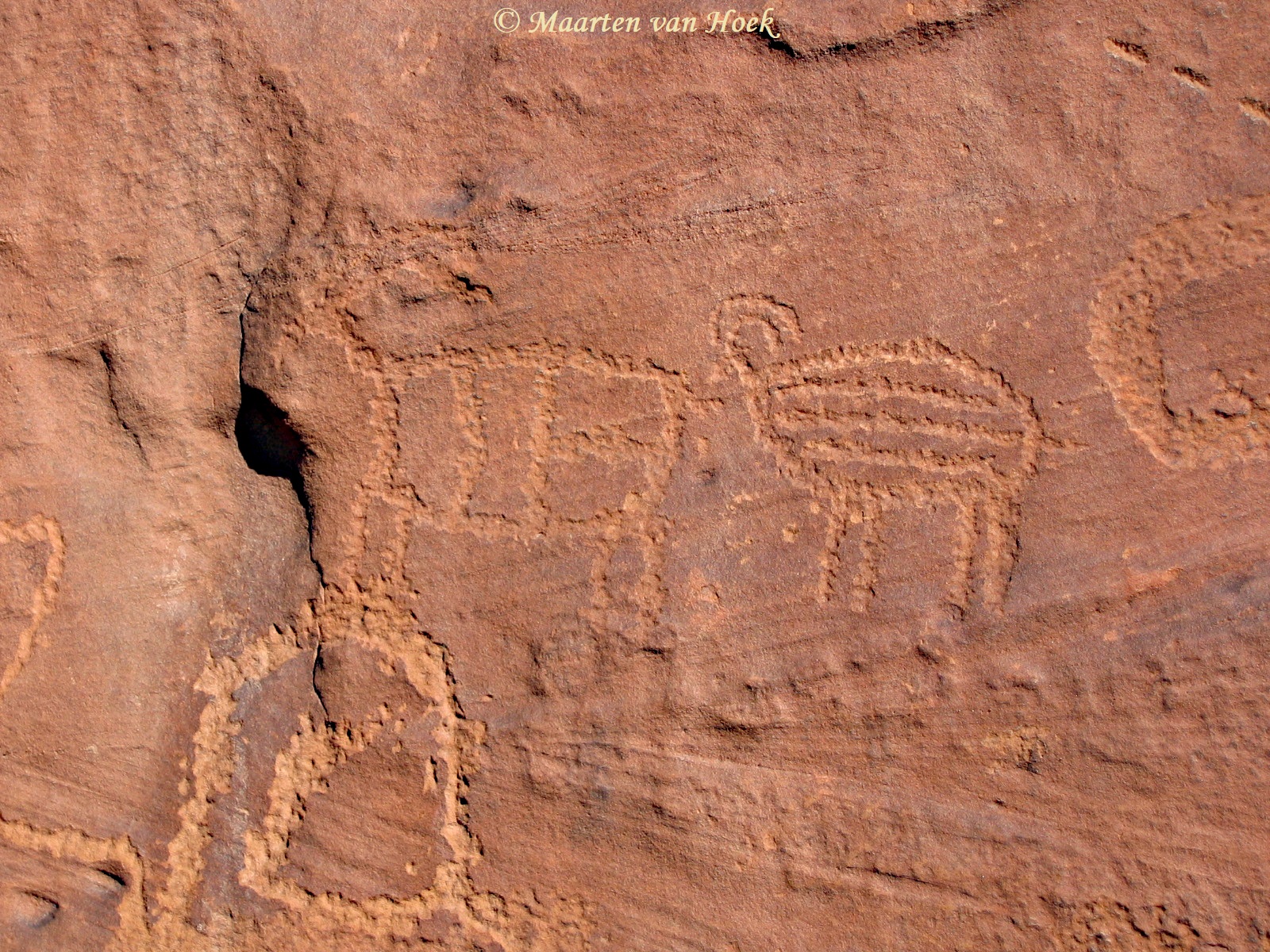
Figure 4. Two Glen Canyon Linear Style Bighorn petroglyphs (male [right] and female?). Detail of the largest decorated panel at Shay Canyon, Indian Creek, Utah (1 in Figure 5) Note the difference in patination and pecking. Photograph © by Maarten van Hoek.
The Glen Canyon Linear Style petroglyphs is found mainly on the largest panel (Figure 5), which also bears some other interesting images. For instance, the whole length of the largest panel is crossed by three very long, parallel, horizontally arranged lines that continue on an adjacent panel (altogether depicting a giant snake?).
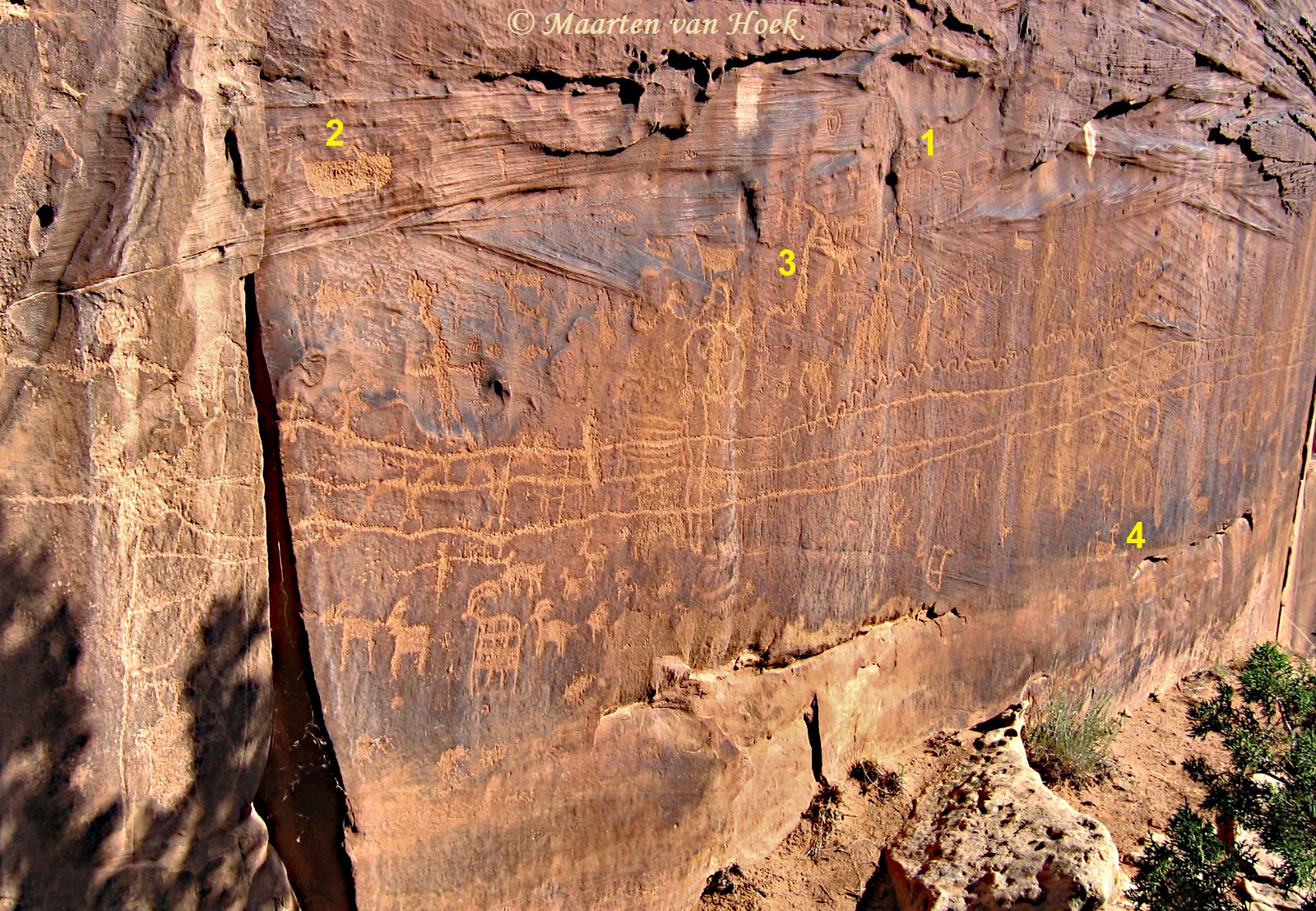
Figure 5. The largest decorated panel at Shay Canyon, Indian Creek, Utah. 1: The two Glen Canyon Linear Style Bighorn petroglyphs (see Figure 4); 2: the complete set of copulating Bighorns (see Figure 6A); 3: a fully pecked “Flute-Player”; 4: the incomplete set of copulating Bighorns (see Figure 6B). Photograph © by Maarten van Hoek.
There are also some rather exceptional images involving quadrupeds, including some scenes. One configuration involves a hunting scene where an archer (on a slightly more recessed panel) aims his bow and arrow onto a quadruped on an adjacent (yet slightly projecting) panel, which is thus invisible for the archer. There possibly are two more isolated archers at Shay Canyon (both on the south facing cliff). Another scene shows a definite copulation scene between two Bighorns (Figure 6A), while another copulation scene clearly is unfinished (Figure 6B). There may even be a third (also unfinished) copulation scene. Enigmatically, a group of three “Flute-Players” seems to be associated with a “Dancing Quadruped” (a shaman in animal disguise?) (Figure 12). The Banner Panel near Moab, Utah, may display three anthropomorphic figures that may (symbolically) be related to the “Dancing Quadruped” (Van Hoek 2015: Fig. 28).
*
The Legs of Quadrupeds at Shay Canyon
What triggered me to write this study are not the many impressive and intriguing rock art images of Shay Canyon, but specific details in several petroglyphs of the quadrupeds. Those details concern the legs of a number of mainly Bighorns, a few deer and some unidentifiable quadrupeds. Those legs seem to be incised, rather than pecked. However, one needs good quality close-up photos of those features to be sure of their nature, and because we did not photograph every quadruped in detail, this study will only describe the feature, also acknowledging that the specific property may well occur elsewhere in Indian Creek (and beyond).
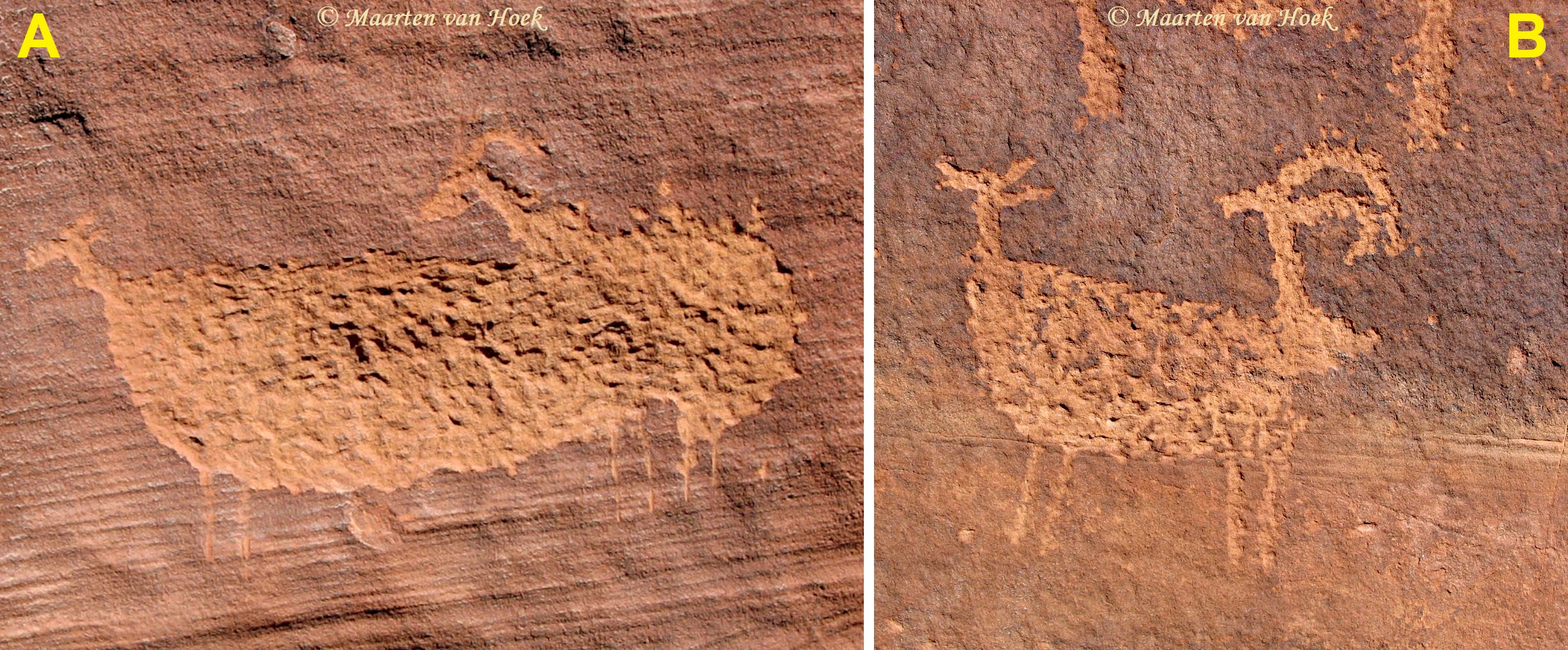
Figure 6. A: The complete set of copulating Bighorns. B: The incomplete set of copulating Bighorns (2 and 4 in Figure 5). Photographs © by Maarten van Hoek.
First of all, most legs of the fully pecked quadrupeds at Shay Canyon are rather thin, but still clearly pecked. However, keep in mind that a fully pecked quadruped may still represent an older image that has skilfully been re-pecked, thus obliterating all previous details. An exception is – for instance – the deeply patinated (thus almost invisible) petroglyph of a quadruped at the Newspaper Rock that has incompletely been re-pecked, thus still showing the original hind legs, while the front legs have crudely been re-pecked (green arrow in Figure 7). This animal is preceded by an almost completely re-pecked Bighorn; only one front leg has been untouched (yellow arrow in Figure 7). However, also at Shay Canyon some petroglyphs of quadrupeds prove to have incompletely been re-pecked (Figure 8).
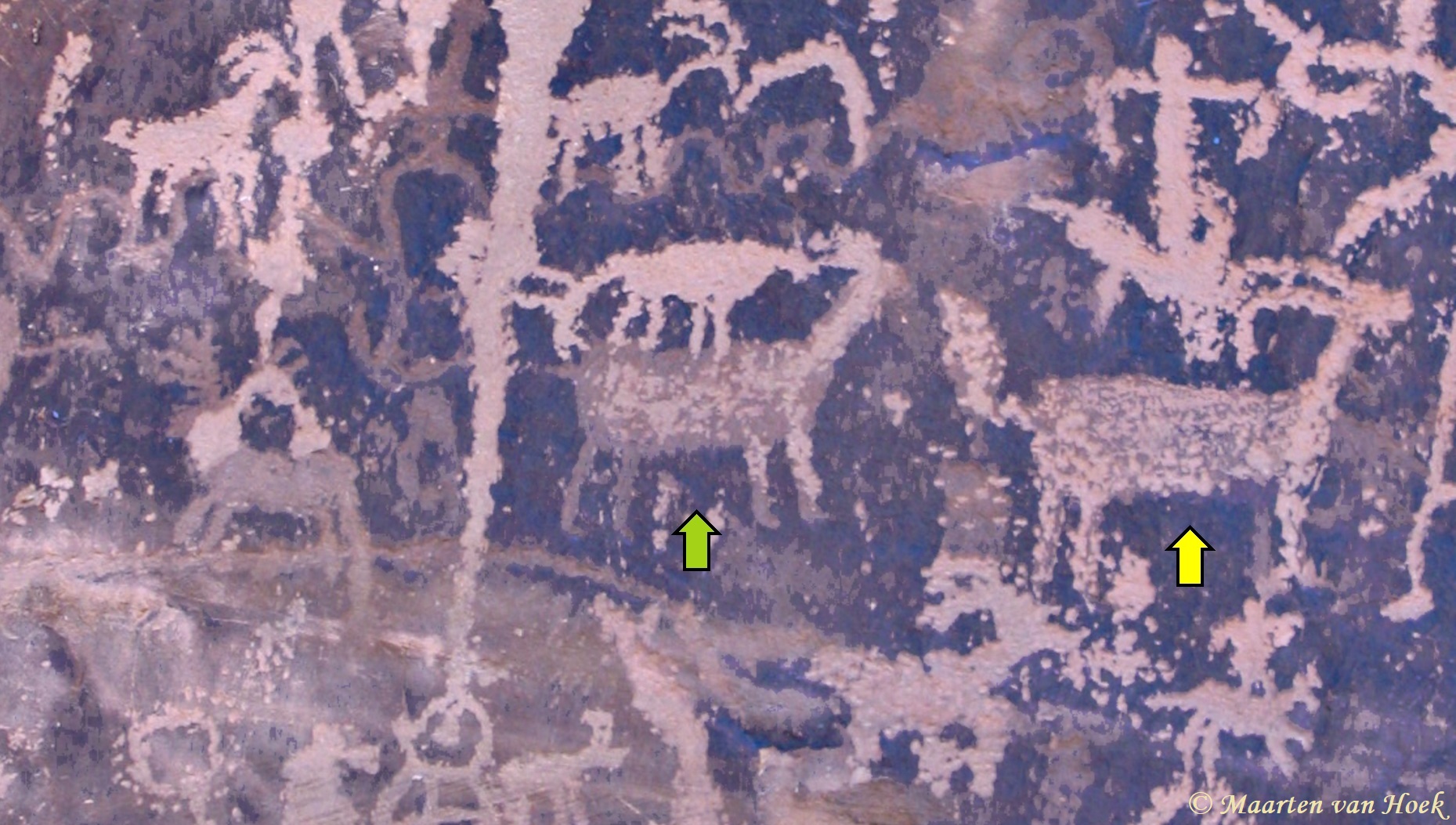
Figure 7. Petroglyphs at the Newspaper Rock (note the differences in patination), showing a partially re-pecked quadruped (green arrow) and an almost completely re-pecked Bighorn (yellow arrow). Some fully pecked images of quadrupeds may well involve earlier petroglyphs that were re-pecked. Photograph (heavily enhanced) © by Maarten van Hoek.
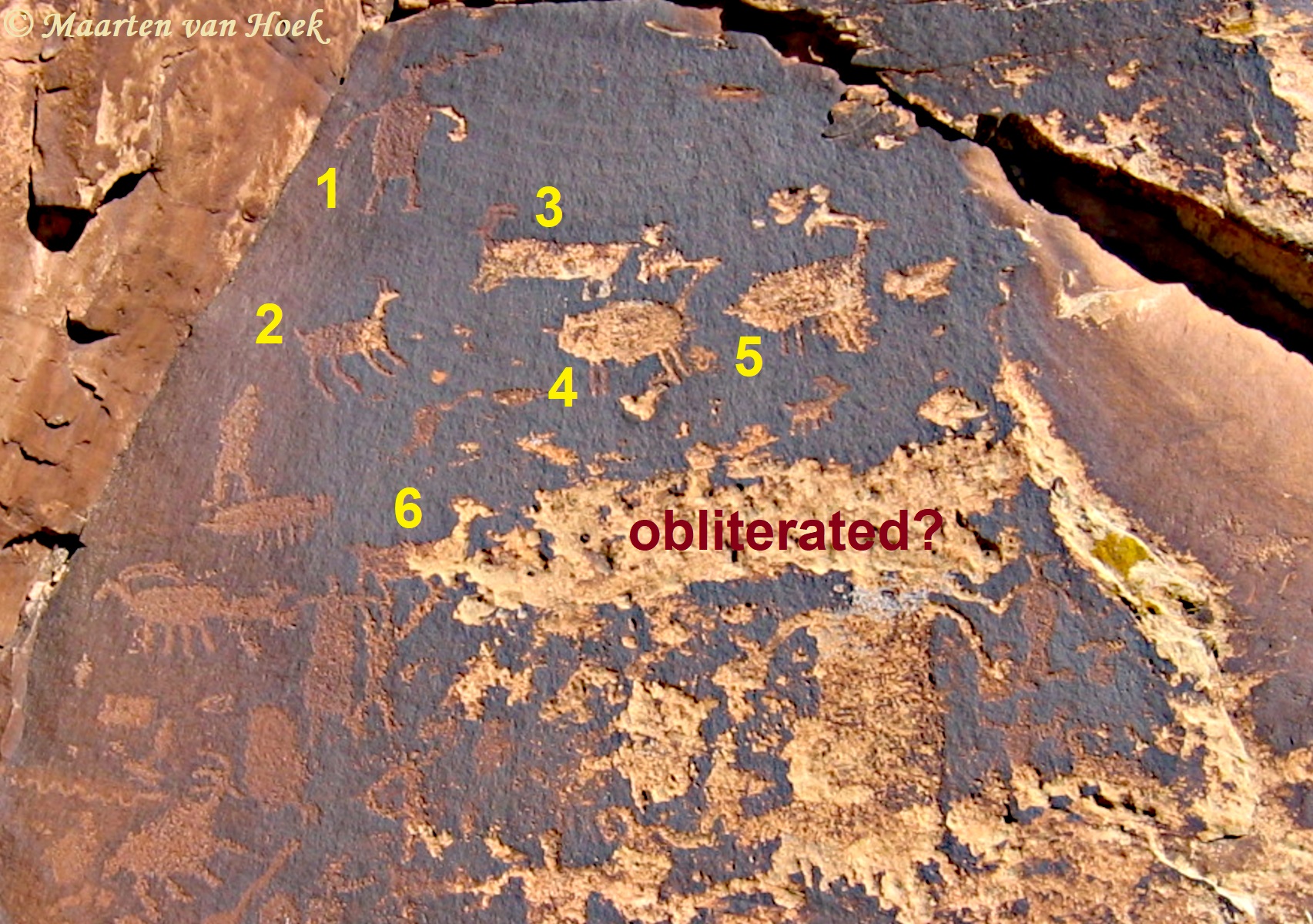
Figure 8. Partially re-pecked petroglyphs at Shay Canyon. A large area may well have intentionally been obliterated. Photograph © by Maarten van Hoek.
However, at Shay Canyon there are also several fully pecked quadrupeds featuring clearly pecked legs that have been superimposed by a straight, incised or abraded groove, yet only partially hiding the pecked legs (Figure 9A). Only very few quadrupeds have legs that are only incised or abraded, not pecked. Examples are the very thin (incised) legs in one of the scenes of copulating Bighorns (see Figure 6A). In one case, it seems that an unfinished petroglyph of a deer has one straight, incised line as the start of an antler (downward pointing arrow in Figure 9B). Moreover, its (previously pecked?) legs seem to have been incised (afterwards?).
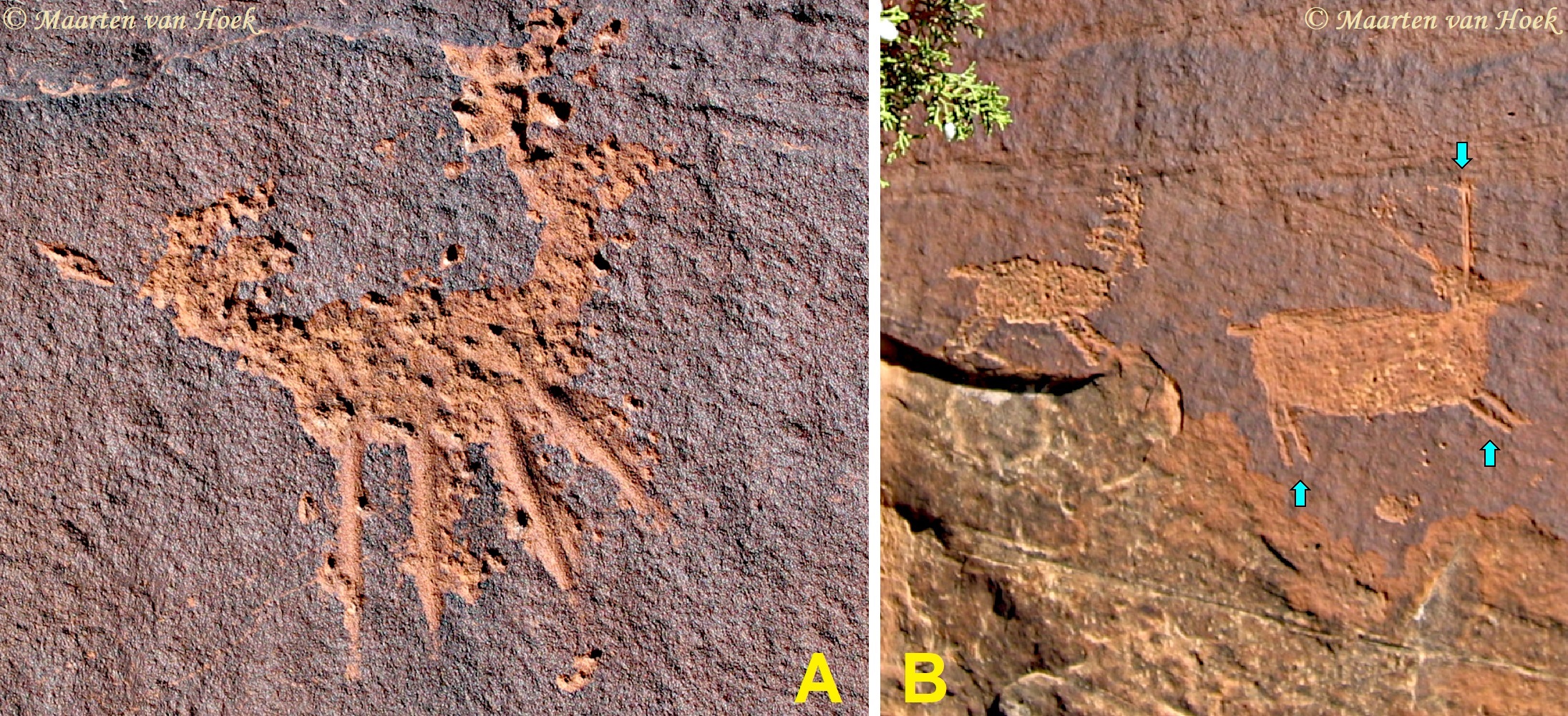
Figure 9. Quadrupeds with incised body elements; “B” an unfinished deer. Shay Canyon. Photographs © by Maarten van Hoek.
The difference between the re-pecking of the previously pecked quadrupeds at the Newspaper Rock (as shown in Figure 7) and the Shay Canyon superimposed incisions (Figure 9A), is that – in my opinion – the Shay Canyon (Anasazi?) incisions involve alterations possibly by the same hand (read: culture) at the “same” time, while the re-pecking of the (Anasazi?) quadrupeds at the Newspaper Rock most likely is a (much) later action by a person of a different culture (for instance by the Ute?).
Possibly and most likely – but I could not check every rock art site in the SW – other sites may also feature this practice. One example may be found at Indian Creek Site-1 (roughly1400 m north of Shay Canyon, but on the east bank of Indian Creek; see Figure 1 for location) where a row of three banana-shaped quadrupeds has been manufactured, one or two with (possibly) incised (hind) legs (Figure 10).
However, in general one really needs very good close-up photographs to be certain of the type and/or sequence of rock art production: (first) pecked; (later) incised? Also many published B&W drawings hardly ever give a clue, especially when fully pecked petroglyphs have confusingly (and in my opinion incorrectly) been drawn as B&W outlined images.
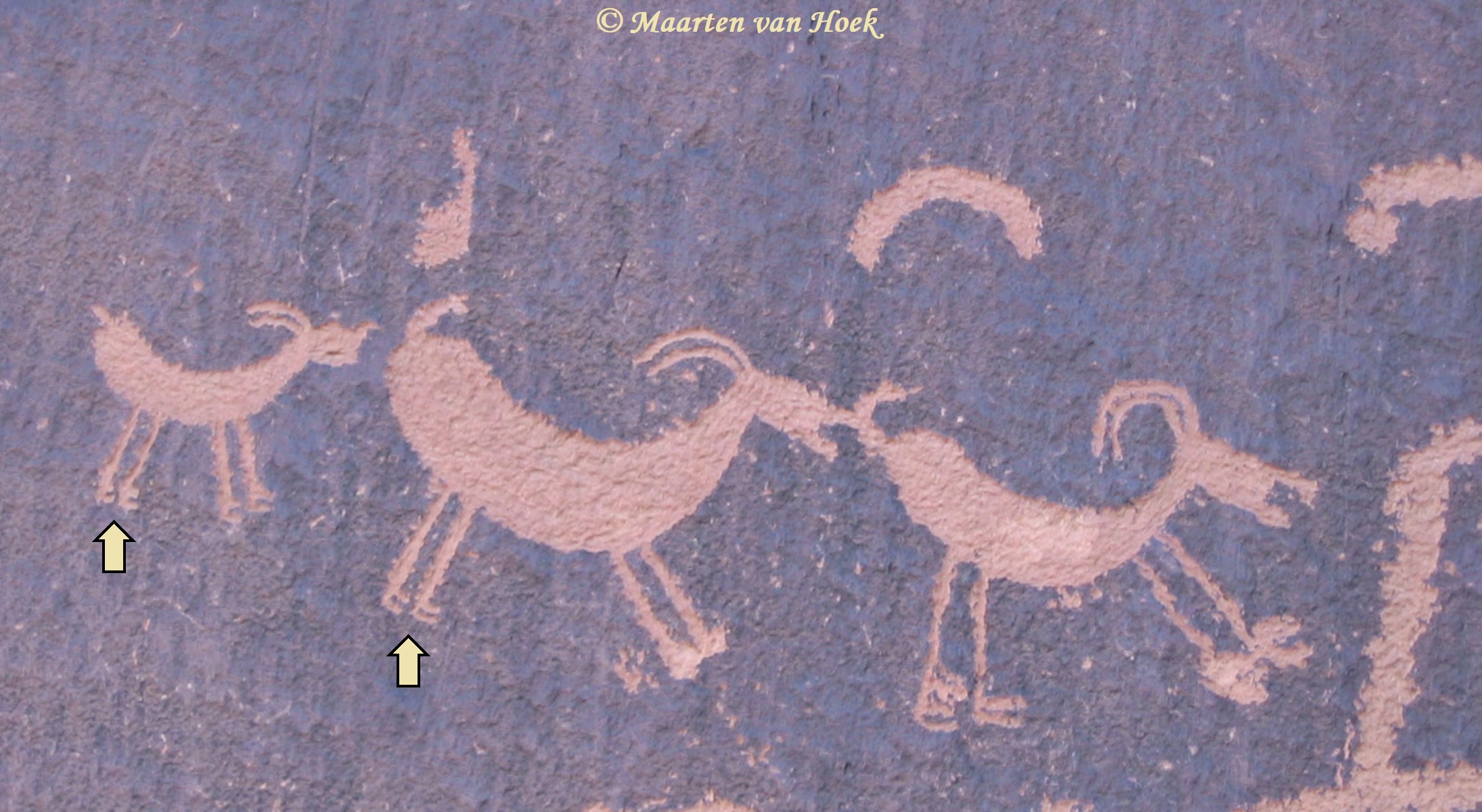
Figure 10. Bighorns (females or males? See the Note at the end) with possibly incised body elements (arrows) at Indian Creek Site-1. Photograph © by Maarten van Hoek.
Of course it is impossible to check all the thousands of quadruped petroglyphs recorded in the SW, but I think that I managed to find some more examples that fit my hypothesis. At the Fremont River rock art site (Capitol Reef National Park, NE Utah) are a number of pecked Bighorn petroglyphs that have clearly incised legs, possibly superimposed upon earlier pecked legs. At the Horseshoe Canyon Site (formerly known as Barrier Canyon) are (previously fully?) pecked petroglyphs of Bighorns of which the legs (especially the fore legs), mouth, ears and horns have been incised. But I could not figure it out whether in these cases there is question of superimposition or not.
Finally, within the scope of this study it is interesting to mention the opposite practice of petroglyphs first being pecked and then incised. Images were (often) pre-scratched in order to produce the desired layout of the image, which was later to be pecked (either fully pecked, or just the outlined lines). The most convincing example of this practice that I can present here, comes from the very old and extensive rock art site of Chillihuay in southern Peru. Although most petroglyphs at Chillihuay have been manufactured by pecking the relatively soft volcanic rock with a pointed (stone) object, there are many instances where especially fine lines have been incised with a much harder and sharper object (like an obsidian flake, or a metal tool). But there is indeed convincing proof at Chillihuay that (some, most, or all?) images were first pre-scratched and then pecked-in, as is evidenced by the abandoned anthropomorphic petroglyph on Panel CHY-D-002 at Chillihuay (Figure 11).
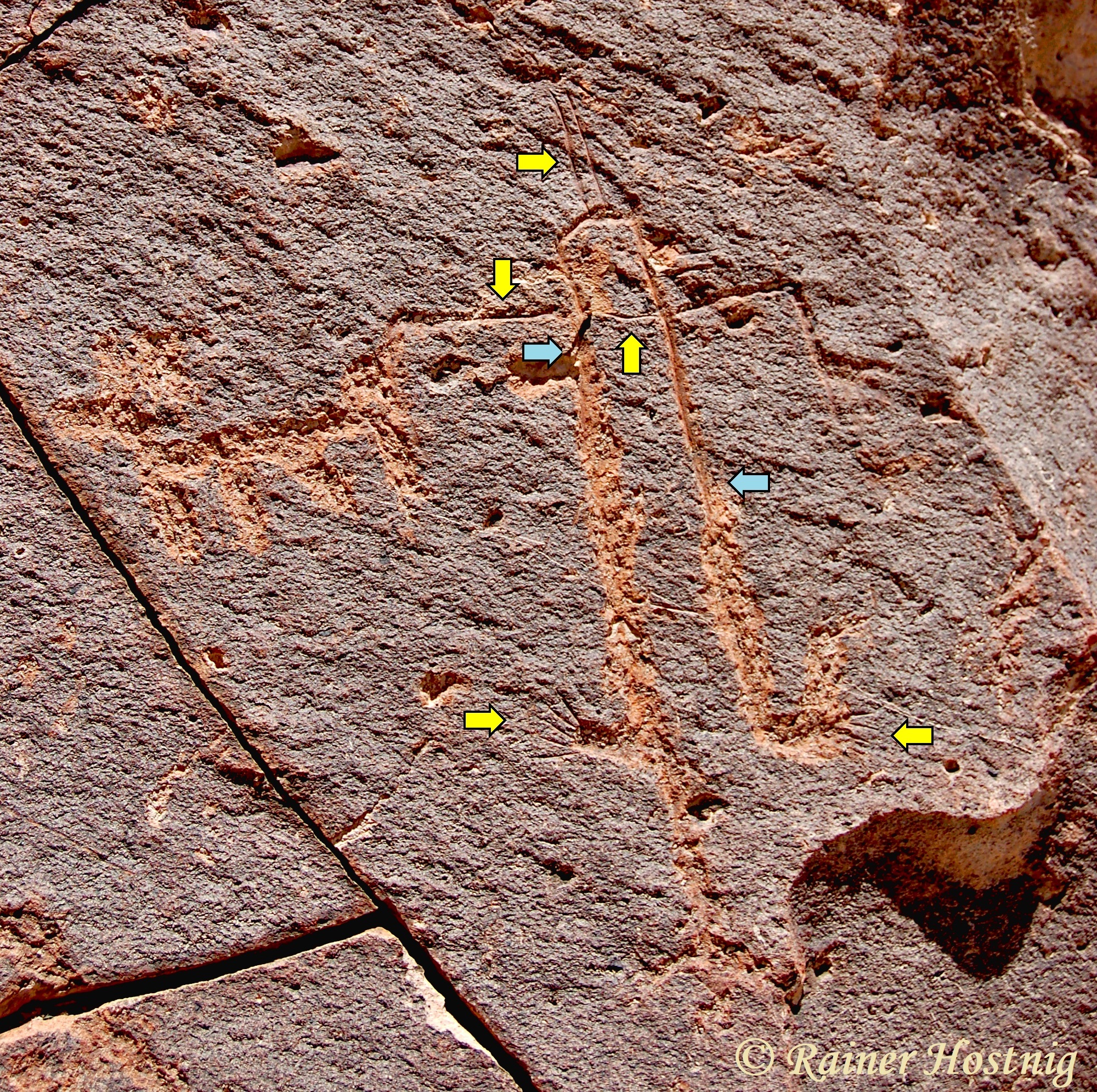
Figure 11. Detail of a partially pecked in, yet pre-scratched anthropomorph on panel CHY-D-002 at Chillihuay, Arequipa, southern Peru. Yellow arrows: incised parts still visible; blue arrows: the upper end of the pecking activity. It is uncertain (but possible) whether the pecked quadruped is associated with the anthropomorph. Photograph © by Rainer Hostnig (2008).
*
Conclusions
It is a fact that most petroglyphs of quadrupeds recorded in SW rock art are pecked, whether in outline or (in most cases) fully pecked. Less frequent are petroglyphs of quadrupeds that are fully incised and/or abraded (like some examples at El Morro, New Mexico). However, this study of quadrupeds recorded at Shay Canyon reveals that in rare cases petroglyphs of quadrupeds have elements that are incised, yet superimposing previously pecked elements. In most cases it especially concerns the legs. I have no explanation for this practice, but I would like to suggest that it is rather easy to incise straight lines, like the legs (thus being a matter of ergonomics). However, I doubt whether this practice has been done to emphasise the legs with the purpose of expressing a specific worldview, otherwise the custom would have been more widespread across the SW. It is also possible that the incisions were made to collect powder imbued with the power of the Sacred Rock Art Site (geophagy).
Finally, the large number of rock art images of quadrupeds at Shay Canyon (and at the Newspaper Rock) confirms the importance of especially Bighorns and deer. Moreover, the ancient manufacturers also included some very special images of the Bighorn and deer, like the examples with incised legs, the possibly three scenes of copulating Bighorns, the very rare scene where an archer shoots an – for him – invisible Bighorn, and the “Dancing Quadruped” (a deer?). All those images, together with the large number of petroglyphs, make Indian Creek an important area – a Sacred Site – regarding rock art production. Whether the enigmatic “Dancing Quadruped” (a re-pecked anthropomorph?) is associated with the surrounding “Flute-Players” creating a scene, is uncertain, but it is possible (Figure 12).
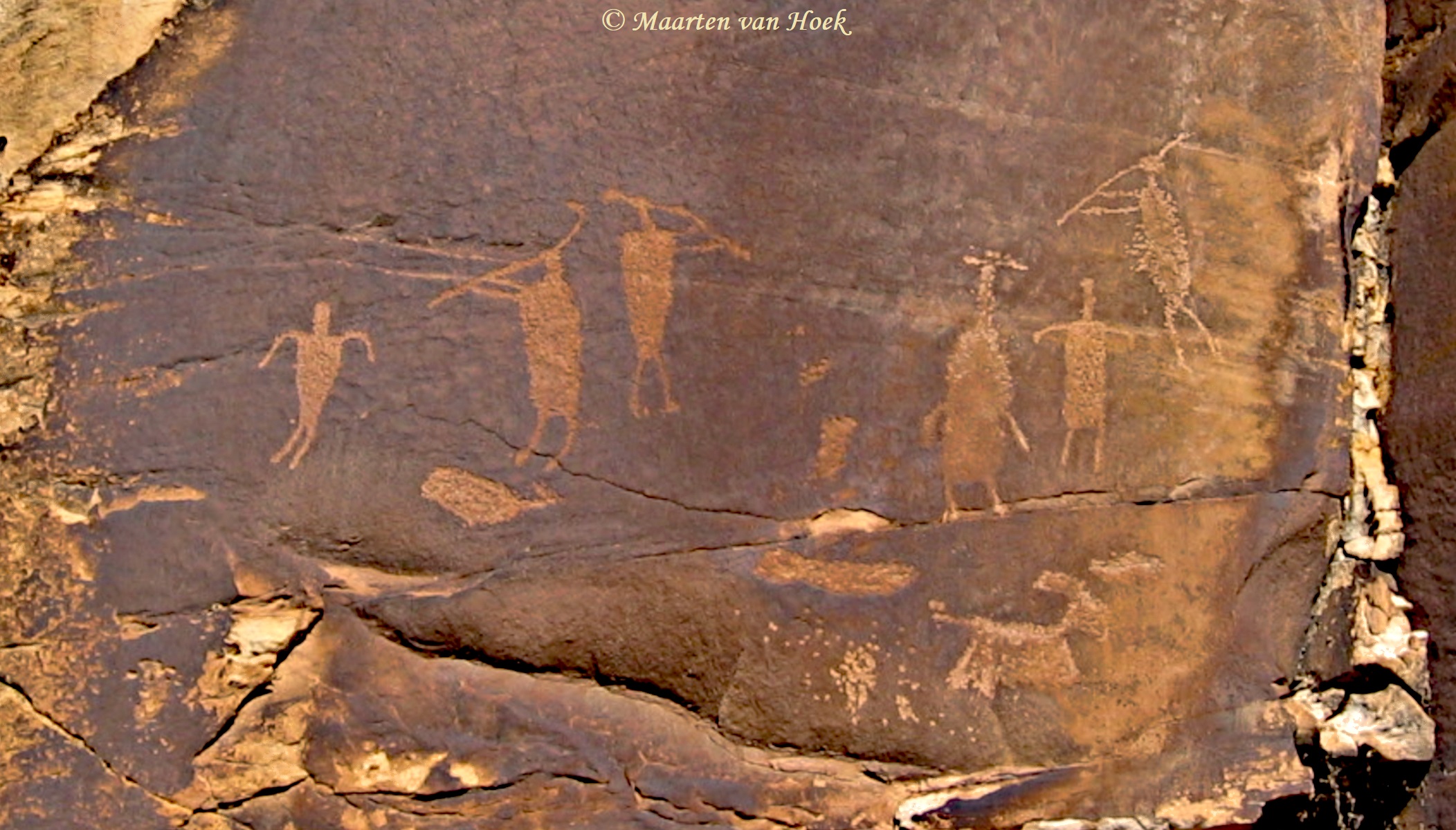
Figure 12. Scene (?) with “Flute-Players”, anthropomorphs and a “Dancing (?) Quadruped”. Note that the top part of the “Dancing Quadruped” (a re-pecked anthropomorph?) may have partially been re-pecked. Also note the unfinished (legless) quadruped at the far left. Photograph © by Maarten van Hoek.
*
Note: After having read some of my publications about SW rock art, Allen Dart of the Old Pueblo Archaeology Center (www.oldpueblo.org) kindly informed me about a physical difference between male and female Bighorns. Although this discrepancy is not really relevant in this current study (although it is mentioned), I may well have been unaware of this distinction in my earlier publications involving Bighorns as well. As a consequence, in some of my earlier publications I may possibly have made errors in interpreting rock art images of male and/or female Bighorns.
Allen wondered whether I had noticed a salient difference in Southwest Bighorn sheep rock art images. He pointed out to me that – in his opinion – depictions of Bighorns seem to favor showing female sheep much more often than male ones. Except for some petroglyphs in the Mimbres and Jornada Mogollon regions of the southern SW, nearly all of the sheep-image petroglyphs and pictographs that he recalls having seen in the SW, have relatively long, slightly curved horns characteristic of female sheep, rather than the thick, curled horns typical of the rams. However, he also informed me that the apparent sex differences that he has noted, are only based on his limited observations of zoomorphic petroglyphs in the southern portion of the SW (Allen Dart: pers. comm. Sept. 2026).
Although I fully agree with Allen’s observations regarding the physical difference between male and female Bighorn horns (based on the photos that he sent me), it still proves to be problematic to classify many Bighorn rock art images as female or male, especially because many of the purportedly thin female horns are also considerably curved. Moreover, in general there are too many graphical exceptions regarding the male-female horns in Bighorn rock art imagery, as there never existed “rules” how to draw a Bighorn. Therefore, when only based on the depictions of the horns, it often will concern a matter of personal interpretation whether an image will be identified as a male or a female Bighorn. This male-female issue is often illustrated and discussed in my paper about the Potash Sheep Shifters (Van Hoek 2015: see for instance Figs 4; 5; 12; 14; 17; 18; 33; 37 [Figure 13]; 41; 45; 46; 50; 63E; 80 etc.: are those Bighorns male or female?). Yet, also my interpretations of the illustrations in my Sheep Shifters paper may be incorrect in (some, many?) cases. Therefore, I leave it to the experts of SW rock art to judge every individual example and to justifiably correct me if I am wrong.
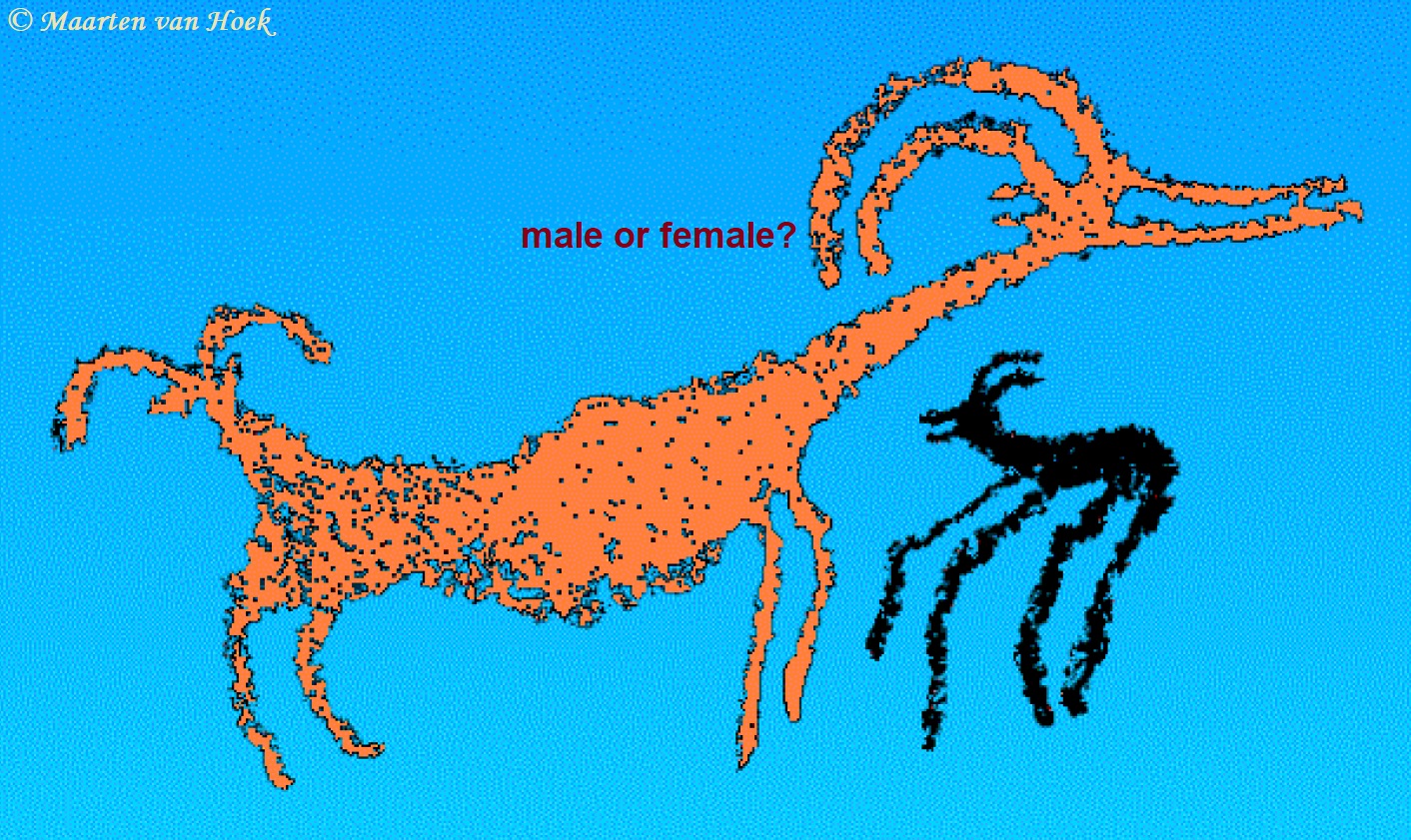
Figure 13. Male or female Bighorn (giving birth?) at Rochester Creek. Utah. Drawing © by Maarten van Hoek, based on a photograph by Ron Wolf.
*
Addendum
In this study I mentioned pictographs that my wife Elles and I recorded at two separate rock art sites both located at the east bank of Indian Creek Canyon. Because I could not find information of those pictographs in the documentation that I have available at home, I think it is useful to include at least the (heavily enhanced) photos of those pictographs here. As we never used GPS, the exact location of the two panels is uncertain, but the pictograph in Figure 13A most likely is found at Indian Creek Site-1 (see Figure 1 for location); the pictograph in Figure 13B may have been recorded by us at Site-2; a short distance north of Site 1.
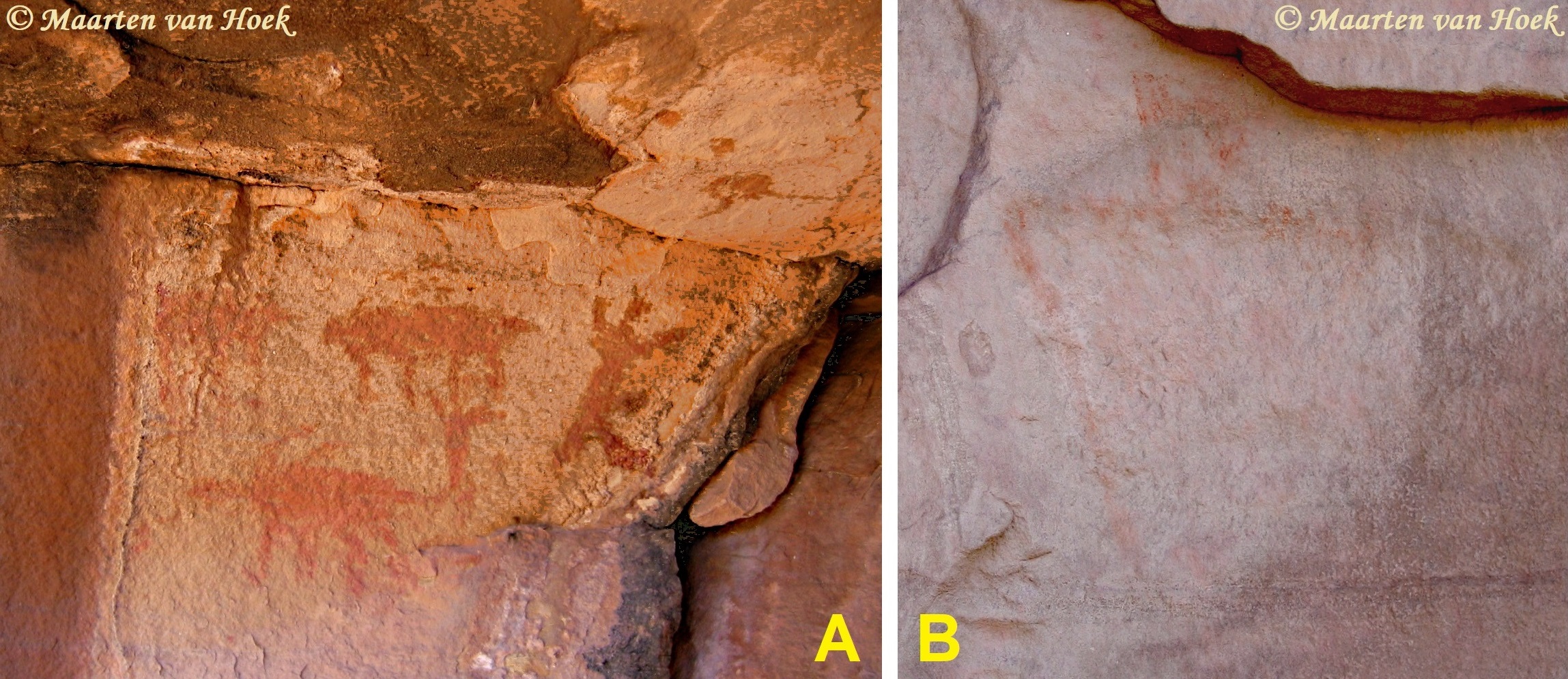
Figure 14. Panels with pictographs at two rock art sites on the east bank of Indian Creek, Utah. A: Quadrupeds; B: Anthropomorph. Photographs © by Maarten van Hoek.
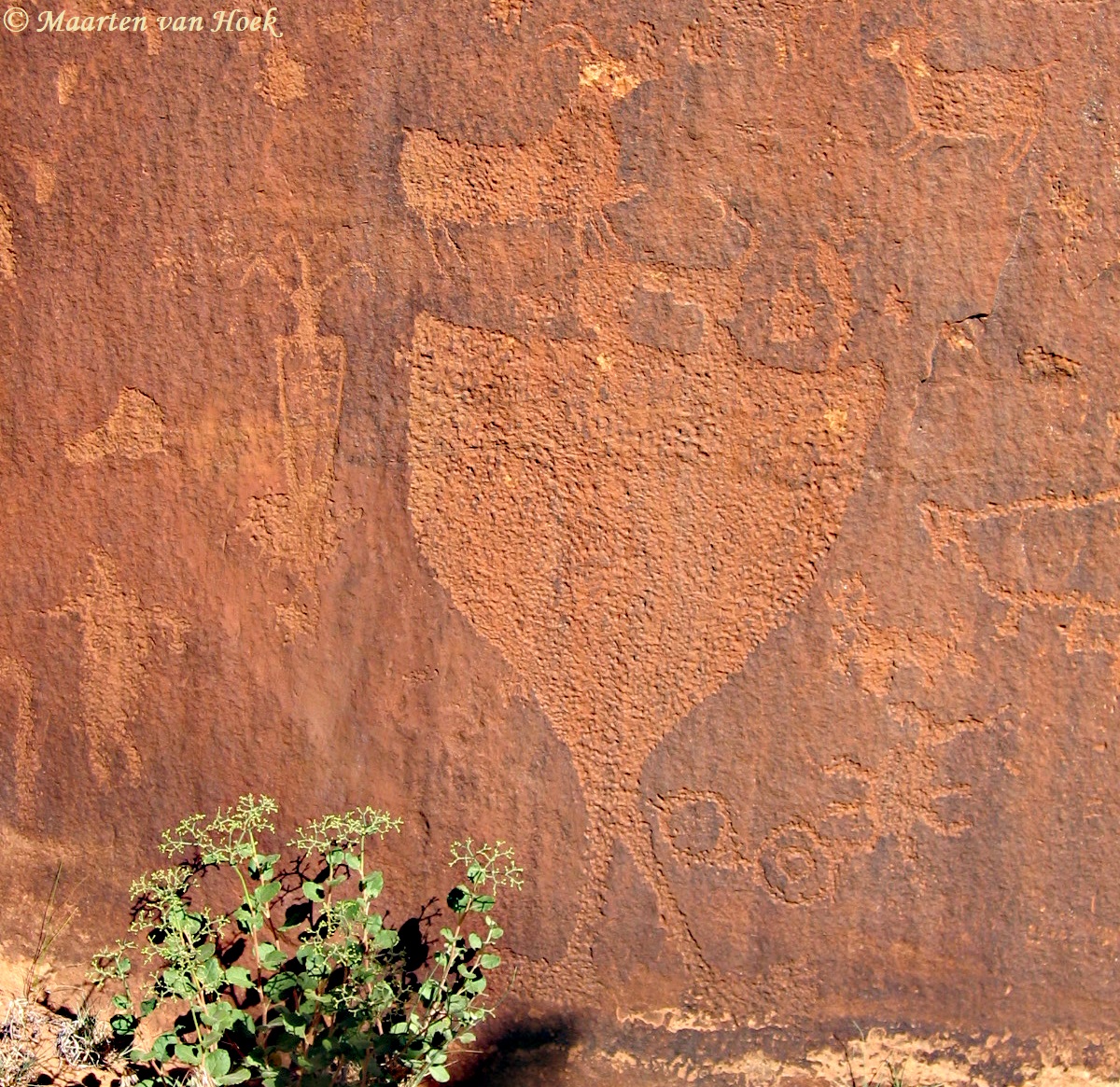
Figure 15. Enigmatic anthropomorph at Shay Canyon. Photograph © by Maarten van Hoek.
*
Acknowledgements
I am grateful to Rainer Hostnig of Cusco, Peru, for sharing with me his photographic collection of the Chillihuay petroglyphs and for his kind permission to use them in my publications. I am also indebted to Allen Dart of the Old Pueblo Archaeology Center for his support and for the useful information he shared with me. Last, but certainly not least, I thank my wife Elles who assisted me during our surveys at Shay Canyon and Indian Creek (and many other sites in the SW), while she continues to support me at home. N.B. All photos in this study have digitally been enhanced by the author.
*
References
Castleton, K. B. 1987. Petroglyphs and Pictographs of Utah. Volume Two: The South, Central, West and Northwest. Utah Museum of Natural History, Salt Lake City.
Slifer, D. 2000. Guide to Rock Art of the Utah Region. Sites with Public Access. Ancient City Press, Santa Fe, New Mexico.
Van Hoek, M. 2010. Mogollon Rock Art and the Status of the ‘Flute Player’. In: PROCEEDINGS OF THE XV WORLD CONGRESS UISPP. Lisbon. BAR International Series. pp. 161 – 173. Archaeopress, Publishers of British Archaeological Reports, Oxford, England.
Van Hoek, M. 2015. The Potash Sheep Shifters. Bighorn Petroglyphs of the Southwest. In: TRACCE – Online Rock Art Bulletin, Italy. Fully illustrated PDF available at Academia, and as PDF-na-5 in DropBox.
*
NOTE. As per June 2026 the website of TRACCE moved to https://www.tracce.eu. The old .net URLS in this paper and earlier published papers should still work. If not, click https://www.tracce.eu to find the relevant paper in the new website of TRACCE.

